Gastroenterology and Hepatology
Deciphering the essence of Gastroenterology and Hepatology
through Human biology
- Identifying unmet needs from daily clinical practice and generating new evidence for the world
- Creating innovative therapies and therapeutics aimed at the cure of digestive diseases
- Accelerating the translation of academic innovations into clinical practice
- Establishing a research hub to elucidate the human biology of digestive diseases
- Creating next-generation gastroenterology through the integration of basic and clinical research, multicenter collaboration, and international partnerships

Following the leadership of the founding Professor Norio Hayashi and the second Professor Tetsuo Takehara, the laboratory has continued to develop to the present day.
With more than 900 alumni members, we work in close collaboration with over 30 affiliated hospitals, engaging in clinical practice, research, and education.
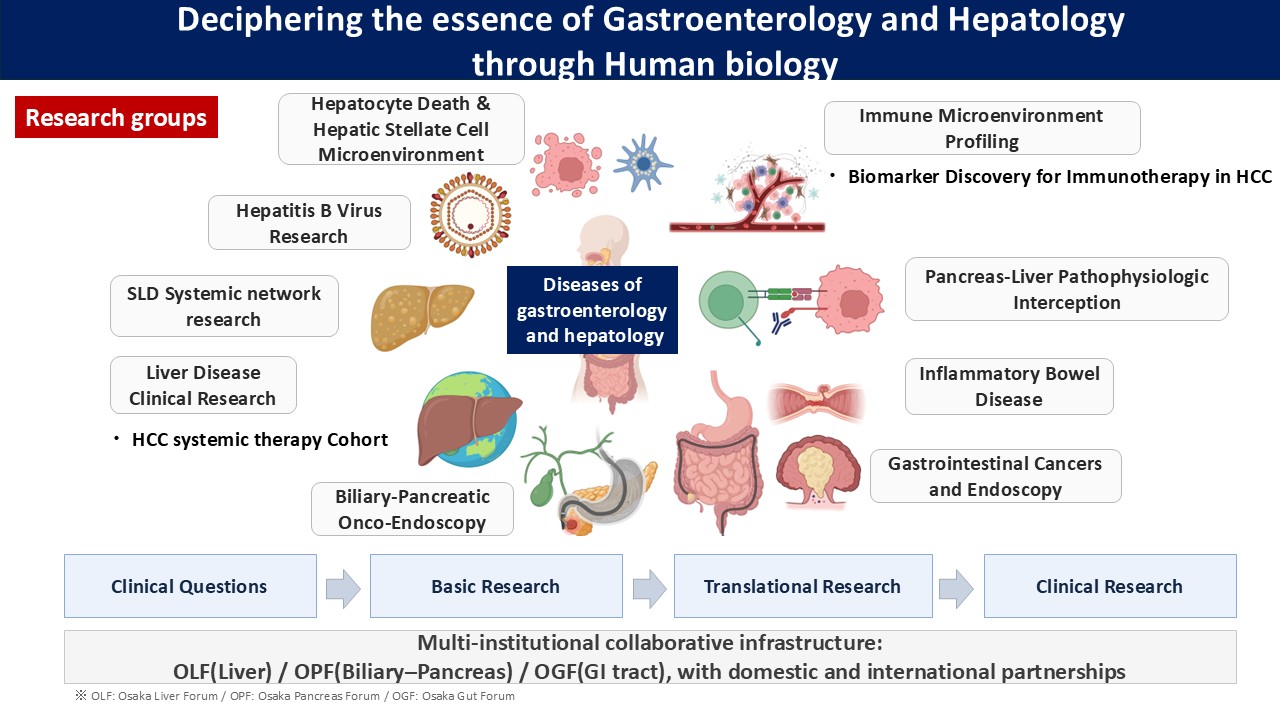
A patient-oriented research framework based on the trinity of “clinically grounded basic research,” “clinical research that returns benefits to patients,” and “innovative translational research.”
We promote research that originates from clinical challenges encountered in daily practice and organically integrates basic research, translational research, and clinical research, with the goal of elucidating disease mechanisms and developing novel diagnostic and therapeutic strategies for digestive diseases.
Our research focuses on liver diseases, biliary and pancreatic diseases, gastrointestinal cancers, and inflammatory bowel disease, and is supported by a comprehensive research framework that spans from molecular pathophysiology to clinical application. In addition, through a multicenter collaborative research structure in partnership with The University of Osaka and affiliated medical institutions, we conduct research based on the Osaka Liver Forum (OLF) for liver diseases, the Osaka Pancreas Forum (OPF) for biliary and pancreatic diseases, and the Osaka Gut Forum (OGF) for gastrointestinal diseases. These platforms support both domestic and international collaborative studies, enabling the validation of clinical questions and the generation of evidence that can be directly translated into real-world clinical practice.
In the field of hepatobiliary and pancreatic diseases, our core focus is on basic and translational research aimed at elucidating the shared molecular foundations underlying disease progression in the liver, biliary tract, and pancreas. In liver disease research, we investigate the pathological cascade from hepatocyte death to inflammation, fibrosis, premalignant lesions, and carcinogenesis. Particular emphasis is placed on interactions with the hepatic microenvironment, including hepatic stellate cells, sinusoidal endothelial cells, and immune cells, as well as on the roles of transcriptional regulation and metabolic dysregulation in disease development. In addition to MASLD and alcohol-associated liver disease, we conduct fundamental analyses of hepatitis B virus (HBV) replication, persistence, and the molecular mechanisms leading to hepatocarcinogenesis, thereby advancing the understanding of shared pathophysiological processes and therapeutic target discovery across chronic liver diseases.
Immunotherapy for hepatocellular carcinoma represents a particularly important research theme. We are engaged in comprehensive analyses of the tumor microenvironment formed by tumor cells, immune cells, and stromal cells. Through multi-omics analyses using clinical specimens and animal models, we aim to elucidate the molecular mechanisms that determine therapeutic response and resistance to immunotherapy, and to identify biomarkers that enable treatment response prediction and the overcoming of resistance.
In the pancreas and biliary tract, we also conduct basic research using animal models and clinical specimens to investigate disease progression from inflammation- and fibrosis-associated premalignant lesions to cancer. Across the liver, biliary tract, and pancreas, we share a common research philosophy centered on the concept of “pathological interception,” which seeks to capture and control the continuous pathological spectrum from inflammation and fibrosis to premalignant lesions and cancer at the earliest possible stages.
The insights obtained from these basic and pathophysiological studies are subsequently translated into multicenter collaborative clinical research based on OLF for liver diseases and OPF for biliary and pancreatic diseases. Within OLF, real-world data and clinical specimens are used to assess disease risk and predict therapeutic outcomes in chronic liver diseases and hepatocellular carcinoma. Within OPF, we focus on optimizing diagnostic and therapeutic strategies for biliary and pancreatic cancers and premalignant lesions, with endoscopic practice centered on EUS and ERCP as the clinical core.
In the field of gastrointestinal diseases, we promote multicenter collaborative research through OGF, focusing on gastrointestinal cancers and inflammatory bowel disease. For gastrointestinal cancers, our efforts center on endoscopic diagnosis and treatment, elucidation of mechanisms of tumor development and progression, identification of novel therapeutic targets and biomarkers, and the development of minimally invasive treatment strategies. In inflammatory bowel disease, we pursue pathophysiological analyses based on multi-omics approaches focusing on the gut microbiota, lipids, and glycans, alongside the development of biomarkers for evaluating treatment response and disease activity. Through these efforts, we aim to establish precision medicine grounded in disease biology.