Advanced Artificial Intelligence Medicine
- Integrating medical data to predict disease onset and progression
- AI-driven patient stratification for personalized medicine
- Unraveling molecular mechanisms of disease through omics analysis
- Developing AI systems for real-world clinical implementation
- Detecting early signs from time-series data for diagnosis and prevention

Integration of prediction, stratification, and mechanism discovery through AI and multimodal medical data
In our laboratory, we conduct biomedical research using AI and mathematical sciences under the guiding concept of “reading the future from data.” We work with a wide range of data, including electronic health records, health check-up data, medical imaging, genomics and other omics data, as well as wearable time-series data. By integrating these diverse data sources, we aim to uncover new perspectives on disease.
First, we focus on predicting disease onset and progression. For example, we have developed approaches to identify early risk patterns of nephrotic syndrome several years before onset by analyzing combinations of prior diseases (Chida et al., Comput Biol Med 2025) (Fig.1). We have also extracted temporal patterns of vaccine adverse reactions using tensor decomposition (Ikeda et al., iScience 2022). Through these studies, we develop methods to detect subtle signals embedded in complex time-series data, with the goal of enabling early diagnosis and prevention.
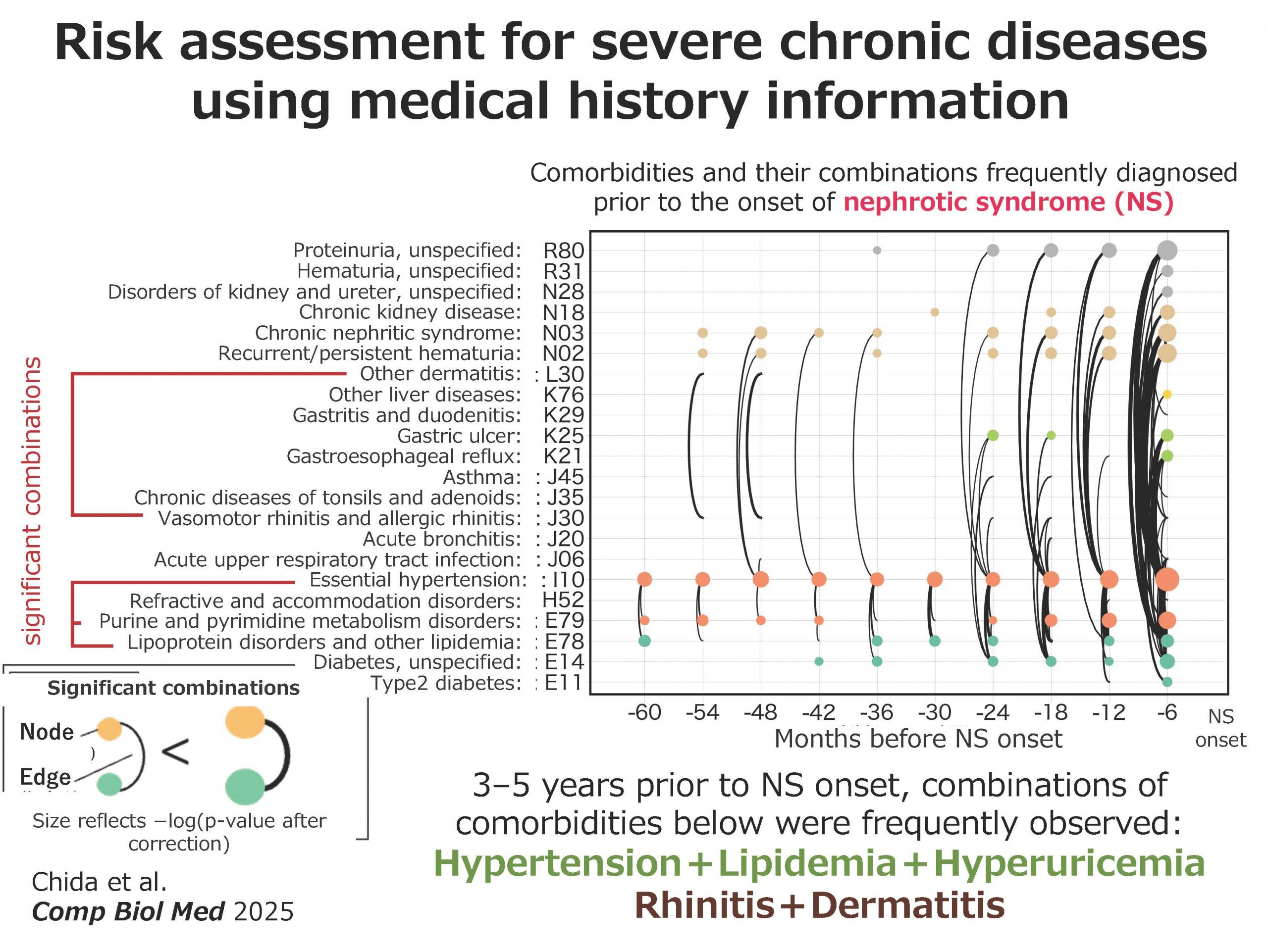 Figure 1
Second, we use AI to capture patient heterogeneity and achieve a more refined understanding of disease. In ovarian cancer, we demonstrated that even among early-stage patients, there exist distinct subgroups with different prognoses by applying machine learning to blood test data (Kawakami et al., Clin Cancer Res 2019) (Fig.2). In this way, AI enables us to visualize previously unrecognized differences among patients and opens new avenues for personalized medicine. We are also developing models that robustly predict subtypes of diseases such as diabetes (Tanabe et al., Diabetologia 2024).
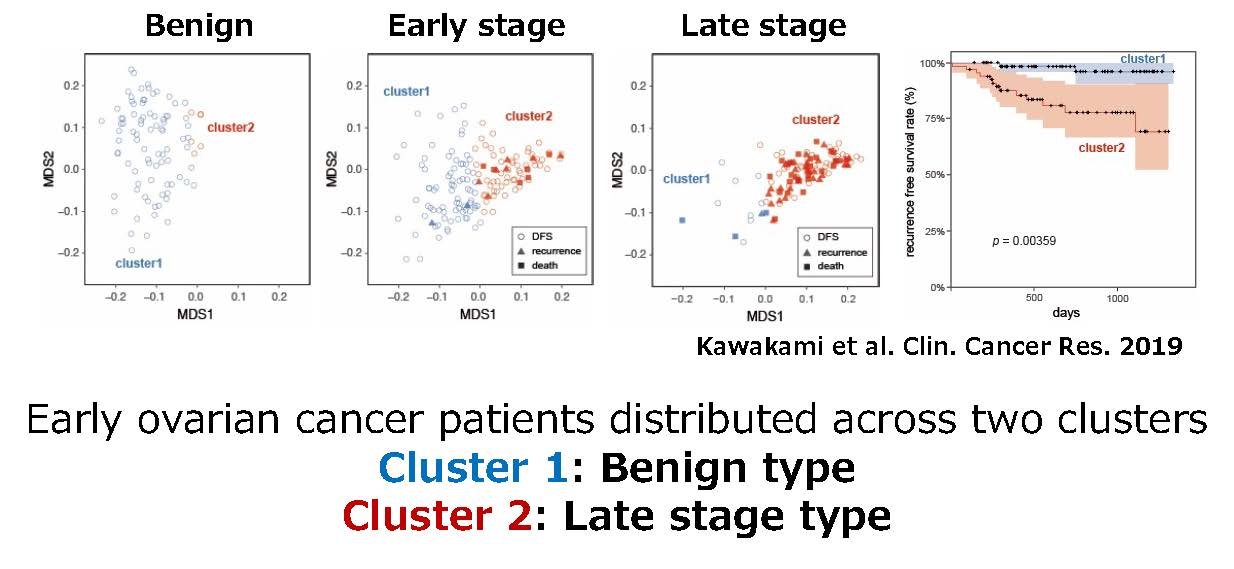 Figure 2
Third, we aim to understand the molecular mechanisms underlying these findings through omics data and network-based approaches. By integrating large-scale ChIP-seq datasets, we developed a method to accurately infer transcription factor activity from gene expression data (Kawakami et al., Nucleic Acids Res 2016). We have also identified molecular signatures associated with disease phenotypes and treatment responses in skin diseases using transcriptomic analysis (Fukushima-Nomura et al., Nat Commun 2025). In addition, we study infectious diseases by integrating animal models with human data to better understand immune responses.
A key feature of our research is the integration of “prediction,” “stratification,” and “mechanistic understanding” into a unified framework. Insights derived from data are used to generate new hypotheses, which are then tested and refined in an iterative cycle. Through this process, we aim to create new forms of medicine. Rather than using AI as a mere tool, we view it as a means to expand how we understand and practice medicine—this perspective lies at the core of our research.