Pancreaticobiliary Diseases
Diseases in the pancreatic and biliary tracts range from benign inflammatory lesions to malignant tumors, and diagnosis and treatment of these diseases require a high level of expertise in this field. While early diagnosis of pancreatic and biliary tract cancer is particularly difficult, treatment options are increasing every year, and accurate staging and strategic treatment planning in collaboration with multiple disciplines have a significant impact on the prognosis and quality of life of patients. Based on advanced endoscopic care including endoscopic ultrasound (EUS), EUS-TA, and endoscopic cholangiopancreatography (ERCP), the Department collaborates with numerous organizations including the Department of Gastroenterology, Department of Radiology, Department of Pathology, IVR Center, Oncology Center, and Palliative Medicine Center to provide medical care optimized to each patient. We provide medical care optimized for each patient.
Pancreatic cancer lacks early symptoms and is often detected at an advanced stage. In our department, in addition to CT and MRI, EUS, EUS-TA, and ERCP are combined for precise diagnosis to evaluate the nature and progress of the tumor from various angles. If jaundice or cholangitis accompanies the tumor, we quickly reduce the yellowing by endoscopic biliary stent and quickly move on to treatment after adjusting the patient's general condition. In cases where the duodenum is obstructed by tumor and conventional ERCP is difficult, we perform biliary drainage using highly specialized techniques such as endoscopic ultrasound-assisted biliary drainage (EUS-BD).
All pancreatic cancer cases are reviewed by the Cancer Board, which is composed of members from various professions including gastroenterological surgery and radiology. In drug therapy, the goal is not only to prolong survival,We also place importance on maintaining quality of life (QOL), and we carefully check side effects and continue treatment while selecting drugs and adjusting doses according to the patient's condition.Comprehensive cancer gene profile (CGP) testing is also actively conducted when necessary to promote personalized medicine.
Biliary tract cancer is difficult to diagnose, and evaluation of the stage and mode of progression greatly influences the treatment plan. In addition to imaging evaluation by CT, MRI, PET-CT, and EUS, we use ERCP and EUS-TA to ensure pathological diagnosis. When lymph node enlargement is observed, EUS-TA is performed aggressively to collect information necessary for treatment selection.
Biliary tract cancer is an area with diverse genetic mutations and a rapidly growing number of corresponding molecularly targeted drugs. In our department, we haveEarly introduction of CGP testing and treatment strategies based on the molecular profile of the tumorIn addition, we have established a system of stents and devices for the treatment of cancer. In addition, we use multiple types of stents and devices in the ablation procedure according to the pathological condition, aiming at management that allows safe and smooth continuation of anticancer treatment.
Recently, immune checkpoint inhibitors (ICIs) have become a treatment option, but immune-related side effects are often a problem. The Department of Oncology is working closely with the Oncology Center, Department of Immunology, Department of Respiratory Medicine, Department of Endocrinology, and other departments to manage side effects and improve safety.
Pancreatic neuroendocrine tumors are,Disease concepts including highly differentiated neuroendocrine tumors (NETs) and poorly differentiated neuroendocrine carcinomas (NECs)and the rate of progression and grade of malignancy vary greatly from tumor to tumor. Therefore, accurate histological diagnosis is the foundation for treatment planning. The Department actively performs EUS-TA to precisely evaluate the Ki-67 index and other pathological information. We also perform PET-CT and somatostatin receptor scintigraphy (Octreoscan) as needed and offer peptide receptor radiation therapy (PRRT) in SSTR receptor-positive cases. The treatment plan is comprehensively reviewed in collaboration with multiple departments including gastroenterology, gastroenterological surgery, radiology (diagnostic imaging and nuclear medicine), and in the case of functional NEN, endocrinology.
Accurate diagnosis is crucial because AIP and IgG4-SC are often difficult to differentiate from pancreatic cancer. The Department emphasizes histological evaluation using EUS-TA and biliary biopsy under ERCP, and reevaluation is performed as necessary after the start of treatment to ensure that the coexistence of malignancy is not overlooked. While the disease responds well to steroid therapy, there is a risk of relapse, so we provide comprehensive follow-up using a combination of imaging, endoscopy, and biomarkers.
Pancreatic cystic lesions require careful evaluation because they include a wide range of pathologies from benign to malignant. Since typical IPMN and MCN have the potential to become malignant in the future, our department performs a detailed internal structural evaluation by EUS, and when the indication for surgery is suspected, we discuss it at the Cancer Board jointly with the Department of Gastroenterological Surgery and the Department of Radiology so that we can propose a treatment plan according to individual pathologies without excess or deficiency.
Primary sclerosing cholangitis (PSC) is a designated incurable disease that causes chronic inflammation and stricture of the bile ducts and requires long-term specialized treatment and continuous follow-up. Progression of the disease can lead to cirrhosis and liver failure, and liver transplantation may be necessary. In collaboration with the Transplant Surgery Department, we evaluate the indication for transplantation at the appropriate time.
Since PSC is an important risk factor for cholangiocarcinoma, the Department performs ERCP when imaging studies show suspicious findings, and actively conducts pathological examination of the bile duct stricture to exclude malignancy. In cases with biliary stasis or cholangitis, we perform biliary drainage by balloon dilation or endoscopic stenting to control the decline in liver function and delay or avoid liver transplantation as much as possible.
In addition, since inflammatory bowel disease (IBD) is a complication at a high rate, we provide comprehensive medical care in collaboration with the IBD team. We have participated in clinical trials for PSC and are committed to advanced medical care.
Under a system that can consistently provide endoscopic care, medical management, and liver transplantation medicine, we aim to provide optimal medical care from a long-term perspective for the intractable disease called PSC.
Advanced endoscopic techniques such as EUS/EUS-TA/ERCP/EUS-BD are used to improve both diagnostic accuracy and safe treatment.
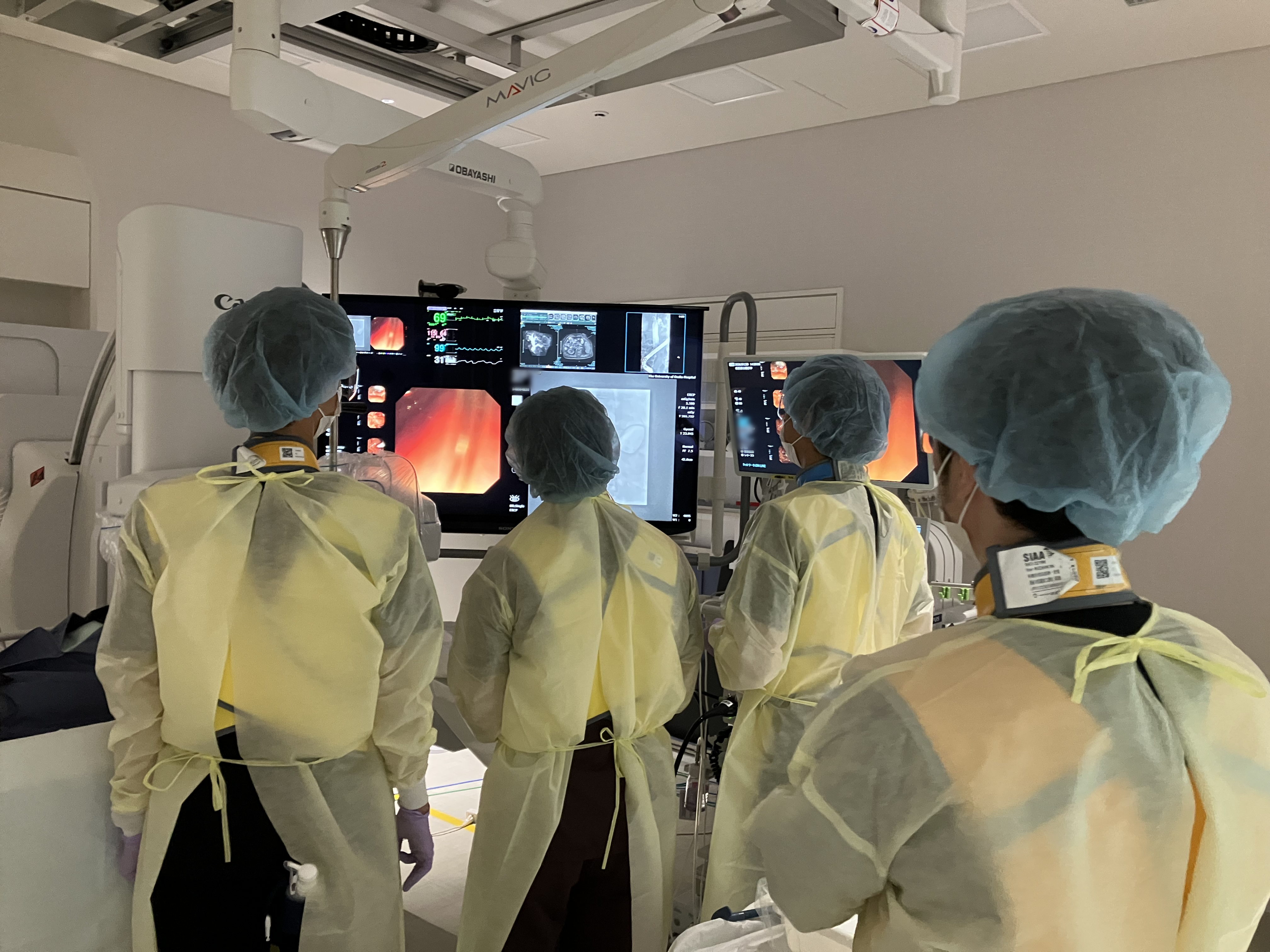
In collaboration with multiple departments and professions, including gastroenterological surgery, oncology, radiology, pathology, and the Oncology Center, we consider optimal treatment strategies based on oncological evidence, emphasizing not only prolonged survival but also quality of life (QOL). Furthermore, we promote personalized medicine based on the results of comprehensive cancer gene profile (CGP) testing.
Based on the Cancer Board, we emphasize appropriate evaluation and long-term follow-up for conditions with future risks such as PSC, IgG4-related diseases, and cystic pancreatic tumors.