
Biliopancreatic Onco-Endoscopy Group
Group Leader: Teppei Yoshioka
Concept: Endoscopy-driven Oncology
Biliary pancreatic cancer continues to have a poor prognosis among gastrointestinal cancers and is an area with many unmet needs, such as difficulty in early diagnosis, resistance to treatment, and a high recurrence rate. On the other hand, the treatment of cholangiopancreatic cancer is now undergoing a period of change with the spread of diagnostic techniques, drug therapy, and genomic medicine. We, the Biliary and Pancreatic Group, have adopted the concept of “Endoscopy-driven Pancreatobiliary Oncology” with the aim of accelerating this change "onsite". We are promoting medical care and research that will benefit biliopancreatic cancer patients by integrating drug therapy, genomic medicine, and basic research, starting with precise diagnosis and endoscopic treatment with EUS/ERCP at the core.
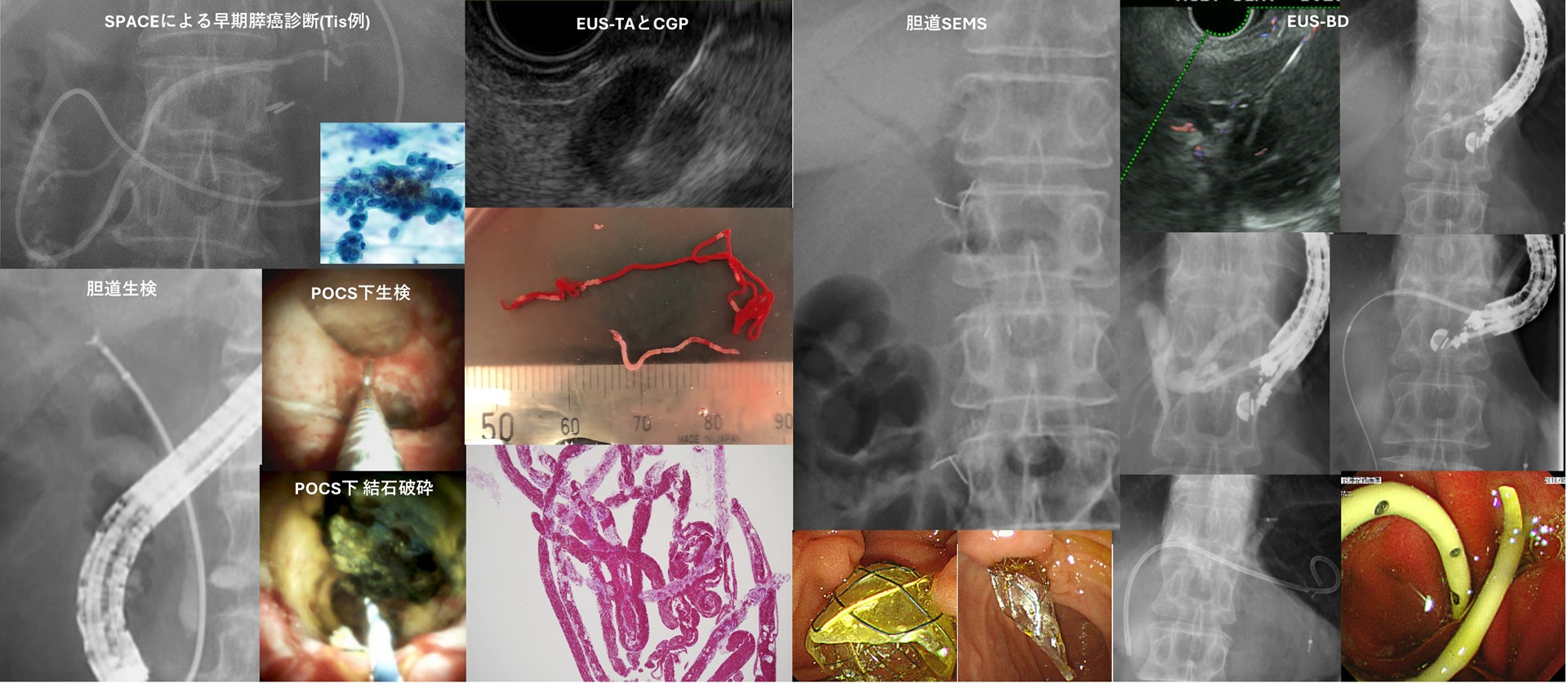
Strategies for integrating EUS/ERCP-based endoscopic practice with drug therapy
The core of our group's practice and research is the integration of endoscopic care based on EUS/ERCP and drug therapy. In the treatment of cholangiopancreatic cancer, endoscopic care is an essential foundation for the safe introduction and continuation of drug therapy, and the two interact with each other to influence treatment outcomes. In our group, clinical research to optimize preoperative treatment and drug therapy based on endoscopic diagnosis using EUS/ERCP and treatment such as biliary drainage is the most important theme. Furthermore, we are working to improve the quality of specimens obtained by EUS-TA, and have established a system for securing and submitting specimens that can withstand cancer gene panel testing. We have been studying the usefulness of EUS-TA for lymph node metastasis of biliary tract cancer1), the relationship between initial drainage strategy and prognosis in hilar bile duct cancer2), the risk of cholangitis after EUS3), the importance of long-term surveillance for cystic lesions in the pancreas4), the safety and usefulness of pancreatic fluid cytology under ERCP5), and so on. 5), the importance of long-term surveillance for pancreatic cystic lesions4), and the safety and usefulness of pancreatic fluid cytology under ERCP5).
Creating Real World Evidence through OPF Multicenter Research
In order to update the standard of care in biliopancreatic medicine, it is essential to accumulate and objectively verify cases at multiple institutions. Our group is collaborating with Osaka University-affiliated institutions, mainly through the Osaka Pancreas Forum (OPF), a multicenter collaborative research platform, to accumulate and analyze real-world data related to biliopancreatic care. We have reported clinical studies based on multicenter data, such as the efficacy of endoscopic drainage for postoperative bile leak6) and the relationship between observation interval and prognosis of IPMN coexistent pancreatic cancer7). Several OPF studies are still ongoing, including a registry of locally advanced pancreatic cancer, a risk assessment of seeding after EUS-TA (intervention study), and a prospective study of biliary tract cancer treatment with ICI, aiming to generate evidence for updating the standard of care in biliopancreatic practice.
Translational and basic research linked to endoscopic practice
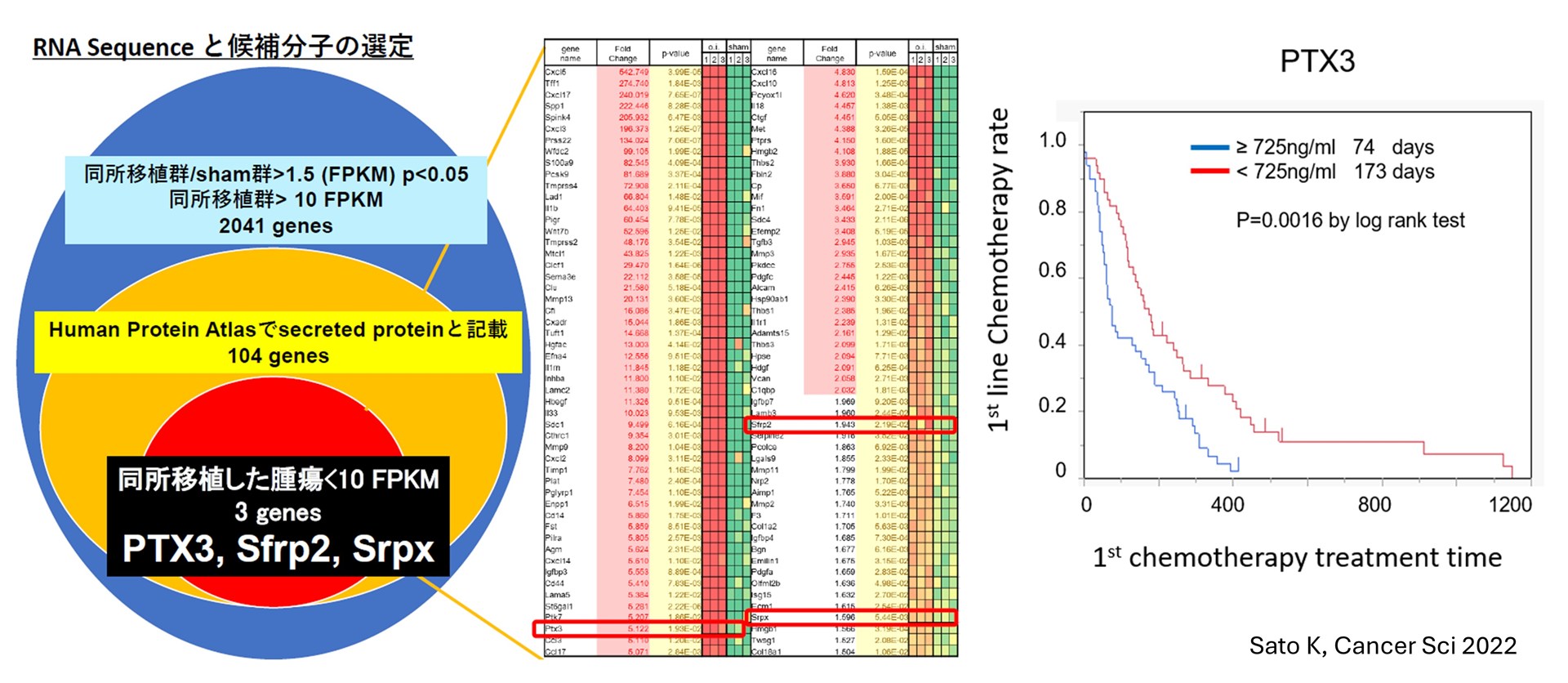
Clinical specimens obtained from endoscopic and medical examinations are utilized to develop basic and translational research leading to the elucidation of the pathogenesis of cholangiopancreatic cancer. We have reported serum biomarker studies such as the serum Tenascin-C study8) that showed an association between metabolic disorder-related inflammation and pancreatic cancer prognosis, and the identification of serum Pentraxin3 associated with pancreatic cancer cachexia9)(see figure below). We have also disseminated the results of basic research into the pathogenesis and progression mechanisms of biliopancreatic diseases, including the role of Regnase-1 in tumor immune escape10).11-15)
Future Prospects: Creating the Next Standard in Biliopancreatic Care
While unmet needs remain high in the field of biliopancreatology, it is a developing field where advances in diagnostic techniques, therapeutic endoscopy, drug therapy, and genomic medicine are expected to be made. We aim to create the next standard of biliopancreatic care by promoting clinical practice, research, and education in a three-pronged manner. Our mission is to conduct research based on the refinement of endoscopic techniques and drug therapy, to develop issues in the field into research with a mobile team including young patients, and to update the standard of care and disseminate evidence through translational and multicenter research.
Major Papers
- Sato K, Shigekawa M, Yamamoto S, Matsumae T, Sato Y, Yoshioka T, Kodama T, Hikita H, Tatsumi T, Takehara T. Utility and clinical significance of endoscopic Sci Rep. 2025 Jan 27;15(1):3363.
- Sato K, Shigekawa M, Kozumi K, Okabe J, Sato Y, Tamura T, Yoshioka T, Sakamori R, Iwagami Y, Yamada D, Tomimaru Y, Noda T, Takahashi H, Kobayashi S, Eguchi H, Tatsumi T, Takehara T. Initial drainage-related prognostic factors for perihilar cholangiocarcinoma: A single-center retrospective study. Tatsumi T, Takehara T. Initial drainage-related prognostic factors for perihilar cholangiocarcinoma: A single-center retrospective study. . 2022 May 22;3(1):e127.
- Ikezawa K, Shigekawa M, Yamai T, Suda T, Kegasawa T, Yoshioka T, Sakamori R, Tatsumi T, Takehara T. Endoscopic biliary stenting as a risk factor for J Gastroenterol Hepatol. 2021 May;36(5):1263-1266.
- Yoshioka T, Shigekawa M, Ikezawa K, Tamura T, Sato K, Urabe M, Sueyoshi H, Yamai T, Suda T, Sakamori R, Tatsumi T, Takehara T. Risk Factors for Pancreatic Cancer and the Necessity of Long-Term Surveillance in Patients With Pancreatic Cystic Lesions. Pancreas. 2020 Apr;49(4):552-560.
- Yoshioka T, Shigekawa M, Yamai T, Suda T, Kegasawa T, Iwahashi K, Ikezawa K, Sakamori R, Yakushijin T, Hiramatsu N, Tatsumi T, Takehara T. The safety and Pancreatology. 2016 Nov-Dec;16(6):1020-1027.
- Murata J, Shigekawa M, Ishii S, Suda T, Ikezawa K, Hirao M, Matsumoto K, Kegasawa T, Iwahashi K, Iio S, Nakanishi F, Nakazuru S, Yoshida Y, Yamai T, Sato K, Takehara T. Efficacy and associated factors of endoscopic transpapillary drainage for postoperative biliary leakage. Yoshioka T, Hikita H, Tatsumi T, Takehara T. Efficacy and associated factors of endoscopic transpapillary drainage for postoperative biliary leakage. DEN Open. 2023 Aug 17;4(1):e281.
- Yoshioka T, Shigekawa M, Ikezawa K, Hirao M, Ishii S, Suda T, Kegasawa T, Matsumoto K, Iwahashi K, Murata J, Kaneko A, Nakazuru S, Yamamoto S, Matsumae T, Matsumae T, Kozumi K, Sato Y, Okabe J, Sato K, Hikita H, Sakamori R, Tatsumi T, Takehara T. Kozumi K, Sato Y, Okabe J, Sato K, Hikita H, Sakamori R, Tatsumi T, Takehara T. The relationship between observation interval and prognosis in pancreatic Pancreatology. 2024 Feb;24(1):73-77.
- Sato K, Hikita H, Shigekawa M, Soma K, Yamauchi R, Sung J, Kato S, Sasaki Y, Kudo S, Fukumoto K, Shirai K, Murai K, Tahata Y, Yoshioka T, Nishio A, Saito Y, Kodama T, Sasaki Y, Tatsumi T, Takehara T. The serum tenascin C level is a marker of metabolic disorder-related inflammation affecting pancreatic cancer Kodama T, Sasaki Y, Tatsumi T, Takehara T. The serum tenascin C level is a marker of metabolic disorder-related inflammation affecting pancreatic cancer Sci Rep. 2024 May 26;14(1):12028.
- Sato K, Hikita H, Shigekawa M, Kato S, Sasaki Y, Shinkai K, Fukuoka M, Kudo S, Sato Y, Fukumoto K, Shirai K, Myojin Y, Sakane S, Murai K, Yoshioka T, Nishio A, Kodama T, Sakamori R, Tatsumi T, Takehara T. Pentraxin 3 is an adipose tissue-related serum marker for pancreatic cancer cachexia predicting subsequent Kodama T, Sakamori R, Tatsumi T, Takehara T. Pentraxin 3 is an adipose tissue-related serum marker for pancreatic cancer cachexia predicting subsequent muscle mass and visceral fat loss. Cancer Sci. 2022 Dec;113(12):4311-4326.
- Okabe J, Kodama T, Sato Y, Shigeno S, Matsumae T, Daiku K, Sato K, Yoshioka T, Shigekawa M, Higashiguchi M, Kobayashi S, Hikita H, Tatsumi T, Okamoto T, Satoh T, Eguchi H, Akira S, Takehara T. Regnase-1 downregulation promotes pancreatic cancer through myeloid-derived suppressor cell-mediated evasion of J Exp Clin Cancer Res. 2023 Oct 9;42(1):262.
- Tamura T, Kodama T, Sato K, Murai K, Yoshioka T, Shigekawa M, Yamada R, Hikita H, Sakamori R, Akita H, Eguchi H, Johnson RL, Yokoi H, Mukoyama M, Tatsumi T, Takehara T. Dysregulation of PI3K and Hippo signaling pathways synergistically induces chronic pancreatitis via CTGF upregulation. Takehara T. Dysregulation of PI3K and Hippo signaling pathways synergistically induces chronic pancreatitis via CTGF upregulation. 2021 Jul 1;131(13):e143414.
- Sato K, Hikita H, Myojin Y, Fukumoto K, Murai K, Sakane S, Tamura T, Yamai T, Nozaki Y, Yoshioka T, Kodama T, Shigekawa M, Sakamori R, Tatsumi T, Takehara T. Hyperglycemia enhances pancreatic cancer progression accompanied by elevations in phosphorylated STAT3 and MYC levels. PLoS One. 2020 Jul 1;15(7):e 0235573.
- Kegasawa T, Tatsumi T, Yoshioka T, Suda T, Ikezawa K, Nakabori T, Yamada R, Kodama T, Shigekawa M, Hikita H, Sakamori R, Takehara T. Soluble UL16-binding protein 2 is associated with a poor prognosis in pancreatic cancer patients. Biochem Biophys Res Commun. 2019 Sep 10;517(1):84-88.
- Iwahashi K, Hikita H, Makino Y, Shigekawa M, Ikezawa K, Yoshioka T, Kodama T, Sakamori R, Tatsumi T, Takehara T. Autophagy impairment in pancreatic acinar cells causes zymogen granule accumulation and pancreatitis. Biochem Biophys Res Commun. 2018 Sep 18;503(4):2576-2582.
- Ikezawa K, Hikita H, Shigekawa M, Iwahashi K, Eguchi H, Sakamori R, Tatsumi T, Takehara T. Increased Bcl-xL Expression in Pancreatic Neoplasia Promotes Carcinogenesis by Inhibiting Senescence and Apoptosis. Cell Mol Gastroenterol Hepatol. 2017 Feb 20;4(1):185-200.e1.