Category: Development-en

  • Unified-HILIC/AEX/MS for Polar Metabolomics

    Unified-HILIC/AEX/MS for Polar Metabolomics

    [Background and History of the Research]
    Metabolites include components ingested through diet and those biosynthesized within the body from these components. In diseases, it is frequently observed that specific metabolites are overproduced or depleted. Therefore, detailed and continuous monitoring of metabolic balance is expected to contribute to early disease diagnosis and the development of new treatment strategies. However, it is extremely difficult to simultaneously measure the entire metabolome—comprising thousands of metabolites—in a single analysis. Consequently, cumbersome methods involving the combination of multiple analytical techniques across various platforms have been employed until now. Cohort studies handling large numbers of samples face the challenge of having to select specific analytical methods, which limits the metabolite information that can be utilized.

    [Research Content and Results]
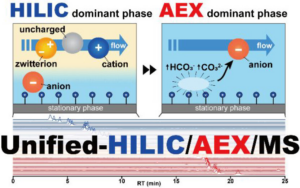
    We focused on the fact that metabolites can be classified into two groups based on their charge: anionic and non-anionic (cationic, zwitterionic, and uncharged). Therefore, we investigated a separation method using a proprietary separation column with primary to tertiary amines and quaternary ammonium cations as the stationary phase. After detailed optimization of conditions, we developed a method in which hydrophilic interaction chromatography (HILIC) to adsorb anionic metabolites onto the positively charged stationary phase, while simultaneously separating and analyzing other cationic, zwitterionic, and uncharged metabolites based on differences in polarity. This is followed seamlessly by anion exchange chromatography (AEX) in the second half of the analysis to separate and analyze the anionic metabolites adsorbed onto the stationary phase based on differences in ionic strength. We named this newly developed separation and detection method “unified-HILIC/AEX/MS” and compared its analytical performance in metabolome analysis with conventional methods. The results confirmed that this method demonstrates superior performance to the measurement methods commonly used worldwide to date in terms of accuracy and the amount of metabolite information obtained.

    【Future Prospects】
    Going forward, this method is expected to revolutionize the metabolic measurements widely used around the world and serve as a new tool for elucidating the mechanisms of various diseases. In our laboratory, we plan to apply this method to metabolic studies of various model organisms, including human samples, with the aim of elucidating the molecular basis of biological phenomena involving metabolism. Furthermore, given this method’s exceptional ability to measure small-molecule compounds, it is expected to be utilized in various fields, such as functional food components, pharmacokinetics, and pesticide residues.

    [Glossary]
    (※1) Liquid Chromatography
    A technique for separating compounds. It uses liquids such as water or organic solvents as the mobile phase. The sample passes through a column along with the mobile phase and is separated as it interacts with the stationary phase within the column. Since the elution time of each compound varies depending on the strength of this interaction, this elution time can be used to identify specific compounds.

    (※2) Mass Spectrometry
    An analytical method in which molecules are ionized, and the mass-to-charge ratio (mass number ÷ charge number) of the traveling ions is separated and detected using electrical and magnetic forces.

    (※3) HILIC
    In liquid chromatography, the name of the separation mode varies depending on the type of interaction. The method that separates compounds using hydrophilic interactions is called hydrophilic interaction chromatography (HILIC).

    (※4) AEX
    In liquid chromatography, the mode in which separation is based on ionic interactions is called ion chromatography. Specifically, when the analytes are anions, this method is called anion exchange chromatography (AEX).

    [Publication Information]
    Journal: Analytical Chemistry
    Title: Unified-hydrophilic-interaction/anion-exchange liquid chromatography mass spectrometry (unified-HILIC/AEX/MS): A single-run method for comprehensive and simultaneous analysis of the polar metabolome
    Authors: Kohta Nakatani, Yoshihiro Izumi, Masatomo Takahashi, Takeshi Bamba. (*Co-corresponding author)
    DOI: 10.1021/acs.analchem.2c03986

  • Polar Metabolome analysis

    Polar Metabolome analysis

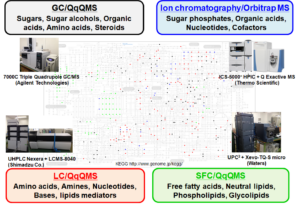
    To comprehensively analyze the polar metabolome, the Baba Laboratory is developing analytical methods such as reversed-phase liquid chromatography mass spectrometry (LC/MS), hydrophilic interaction liquid chromatography mass spectrometry (HILIC/MS), ion chromatography mass spectrometry (IC/MS), and gas chromatography mass spectrometry (GC/MS). By combining these techniques, we perform comprehensive metabolome analyses.

    ・Unified-HILIC/AEX/MS/MS
    ・IC/HRMS
    ・PFPP-LC/MS
    ・ODS-LC/MS

  • Quantitative Lipidomics Method

    Quantitative Lipidomics Method

     Lipids, along with carbohydrates and proteins, are known as the three major macronutrients. They are essential for sustaining life and physical activity, serving as the primary components of biological membranes, a source of energy, and regulators of neural transmission and immune defense. Since lipids consist of various types of fatty acids linked to alcohols (glycerol, sphingosine, sterols) via ester or amide bonds, it is estimated that tens of thousands of different lipid molecules exist in theory. It has been suggested that differences in the composition of these lipid molecules are involved in various diseases, and the identification and quantification of individual lipid molecules are essential for understanding their biological functions and metabolic regulation. In fact, lipidomics—the comprehensive and quantitative analysis of individual lipid molecules—is attracting attention in various research fields, including medical research.
     Because there are a vast number of lipid molecules in the body due to the diversity of polar heads and fatty acid side chains, advanced analytical techniques are required to measure these lipid molecules comprehensively and accurately. An electrospray ionization mass spectrometer (ESI-MS) is a device capable of simultaneously measuring ionized compounds and can be coupled with various types of chromatographs that separate compounds based on differences in elution time. However, a major issue with ESI-MS is that ionization is suppressed by contaminants that elute simultaneously with the target compound. Because the impurities eluting simultaneously with the target compound vary depending on the separation conditions of the chromatograph, completely different quantitative values were calculated at each research facility, making it impossible to accumulate data¹). The Baba Laboratory has developed a novel analytical method that enables comprehensive quantification of lipid molecules in living organisms by optimizing the separation and analysis conditions of the chromatograph and mass spectrometer² (Figure 1).

    Figure 1. Strategy for the quantitative analysis of biological lipid molecules

    To perform quantification using ESI-MS, internal standards corresponding to each lipid molecule must be added to correct for suppression of ionization; however, it is practically impossible to obtain internal standards for all lipid molecules. First, using lipid synthesis standards, we confirmed that lipid molecules within the same lipid class (lipid molecules sharing a common backbone, such as glycerol, or a common polar head group, such as phosphocholine) ionize with similar efficiency. We therefore optimized conditions using supercritical fluid chromatography (SFC) to separate each lipid class based on differences in elution time, and performed measurements by adding internal standards not found in the body for each lipid class. The results showed that quantitative values could be calculated with an accuracy of 64.9% to 103.5% for all lipid classes. Furthermore, the daily variation was kept within 10% for almost all lipid classes, allowing us to overcome the issues related to quantification.

    Figure 1. Strategy for the quantitative analysis of biological lipid molecules

     To perform quantification using ESI-MS, internal standards corresponding to each lipid molecule must be added to correct for suppression of ionization; however, it is practically impossible to obtain internal standards for all lipid molecules. First, using lipid synthesis standards, we confirmed that lipid molecules within the same lipid class (lipid molecules sharing a common backbone, such as glycerol, or a common polar head group, such as phosphocholine) ionize with similar efficiency. We therefore optimized conditions using supercritical fluid chromatography (SFC) to separate each lipid class based on differences in elution time, and performed measurements by adding internal standards not found in the body for each lipid class. The results showed that quantitative values could be calculated with an accuracy of 64.9% to 103.5% for all lipid classes. Furthermore, the daily variation was kept within 10% for almost all lipid classes, allowing us to overcome the issues related to quantification.
     When chromatography elutes lipids of the same class simultaneously, the separation of lipid molecules within that class must rely on mass spectrometry. Therefore, we applied separation using the multiple reaction monitoring (MRM) mode of a triple quadrupole mass spectrometer (QqQ-MS). In MRM mode, ionized lipid molecules are selected, cleaved by an inert gas, and then the resulting fragments are further selected for detection. By detecting fragments derived from the constituent fatty acids cleaved from individual lipid molecules, we were able to identify individual lipid molecules, including their structural isomers (Figure 2).

    Figure 2. Quantitative analysis of lipid molecules in rabbit plasma

     In MRM mode, the target compounds must be determined in advance. To apply this analytical method to all biological samples, we created an in-house lipid MRM library containing lipid molecules found in living organisms. First, we screen for lipid molecules in biological samples using the in-house lipid MRM library. By reconstructing the MRM method based on the detected lipid molecules, we have successfully achieved quantitative lipid analysis for all biological samples. This method is being utilized in various collaborative research projects and is expected to play a role in elucidating new biological functions in the future.

    References

    1. J. A. Bowden, A. Heckert, C. Z. Ulmer, C. M. Jones, J. P. Koelmel, L. Abdullah, L. Ahonen, Y. Alnouti, A. Armando, J. M. Asara, T. Bamba, J. R. Barr, J. Bergquist, C. H. Borchers, J. Brandsma, S. B. Breitkopf, T. Cajka, A. Cazenave-Gassiot, A. Checa, M. A. Cine, R. A. Colas, S. Cremers, E. A. Dennis, J. E. Evans, A. Fauland, O. Fiehn, M. S. Gardner, T. J. Garrett, K. H. Gotlinger, J. Han, Y. Huang, A. H. Neo, T. Hyotylainen, Y. Izumi, H. Jiang, H. Jiang, J. Jiang, M. Kachman, R. Kiyonami, K. Klavins, C. Klose, H. C. Kofeler, J. Kolmert, T. Koal, G. Koster, Z. Kuklenyik, I. J. Kurland, M. Leadley, K. Lin, K. R. Maddipati, D. McDougall, P. J. Meikle, N. A. Mellett, C. Monnin, M. A. Moseley, R. Nandakumar, M. Oresic, R. E. Patterson, D. Peake, J. S. Pierce, M. Post, A. D. Postle, R. Pugh, Y. Qui, O. Quehenberger, P. Ramrup, J. Rees, B. Rembiesa, D. Reynaud, M. R. Roth, S. Sales, K. Schuhmann, M. L. Schwartzman, C. N. Serhan, A. Shevchenko, S. E. Somerville, L. St. John-Williams, M. A. Surma, H. Takeda, R. Thakare, J. W. Thompson, F. Torta, A. Triebl, M. Trotzmuller, S. J. K. Ubhayasekera, D. Vuckovic, J. M. Weir, R. Welti, M. R. Wenk, C. E. Wheelock, L. Yao, M. Yuan, X. H. Zhao, S. Zhou: Harmonizing Lipidomics: NIST Interlaboratory Comparison Exercise for Lipidomics using Standard Reference Material 1950 Metabolites in Frozen Human Plasma. J. Lipid Res. 58. 2275‒2288 (2017).
    2. H. Takeda, Y. Izumi, M. Takahashi, T. Paxton, S. Tamura, T. Koike, Y. Yu, N. Kato, K. Nagase, M. Shiomi, T. Bamba: Widely-targeted quantitative lipidomics method by supercritical fluid chromatography triple quadrupole mass spectrometry, J. Lipid Res. 59. 1283‒1293 (2018).
Back to top