
Introduction
- Metabolomics
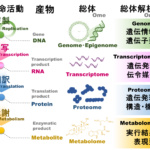 The Human Genome Project, launched in 1990, led to the complete sequencing of the human genome in 2003. While this project estimated that humans have approximately 30,000 genes, it also revealed that there are numerous biological phenomena that cannot be explained by genomic information alone. Consequently, since 2003, the term “post-genomic era” has been used… Read more: Metabolomics
 - The diversity of the physicochemical properties of the metabolome
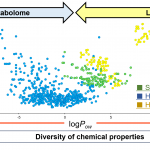 The metabolome is characterized by a wide range of physicochemical properties. These properties include, for example, molecular weight (up to ~2,000), polarity (from low to high), charge characteristics (cationic, zwitterionic, anionic, and uncharged), and molecular stereochemistry (chirality). The figure shows the molecular weights and n-octanol/water partition coefficients (logPow) for a total of 715 standard compounds… Read more: The diversity of the physicochemical properties of the metabolome
 - Supercritical Fluid
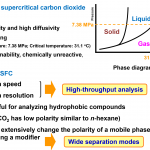 A supercritical fluid (SCF) is a fluid in which both temperature and pressure exceed the critical point of the gas-liquid phase transition; it can be considered an ideal solvent that combines the solubility of a liquid with the diffusivity of a gas. Because the properties of the solvent can be freely adjusted by controlling temperature… Read more: Supercritical Fluid
Development of Analytical Techniques
- Quantitative Lipidomics Method
 Lipids, along with carbohydrates and proteins, are known as the three major macronutrients. They are essential for sustaining life and physical activity, serving as the primary components of biological membranes, a source of energy, and regulators of neural transmission and immune defense. Since lipids consist of various types of fatty acids linked to alcohols (glycerol,… Read more: Quantitative Lipidomics Method
 - Polar Metabolome analysis
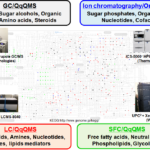 To comprehensively analyze the polar metabolome, the Baba Laboratory is developing analytical methods such as reversed-phase liquid chromatography mass spectrometry (LC/MS), hydrophilic interaction liquid chromatography mass spectrometry (HILIC/MS), ion chromatography mass spectrometry (IC/MS), and gas chromatography mass spectrometry (GC/MS). By combining these techniques, we perform comprehensive metabolome analyses. ・Unified-HILIC/AEX/MS/MS・IC/HRMS・PFPP-LC/MS・ODS-LC/MS
 - Unified-HILIC/AEX/MS for Polar Metabolomics
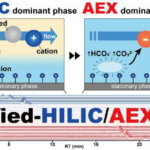 [Background and History of the Research]Metabolites include components ingested through diet and those biosynthesized within the body from these components. In diseases, it is frequently observed that specific metabolites are overproduced or depleted. Therefore, detailed and continuous monitoring of metabolic balance is expected to contribute to early disease diagnosis and the development of new treatment… Read more: Unified-HILIC/AEX/MS for Polar Metabolomics