Unified-HILIC/AEX/MS for Polar Metabolomics
 MetaboAdmin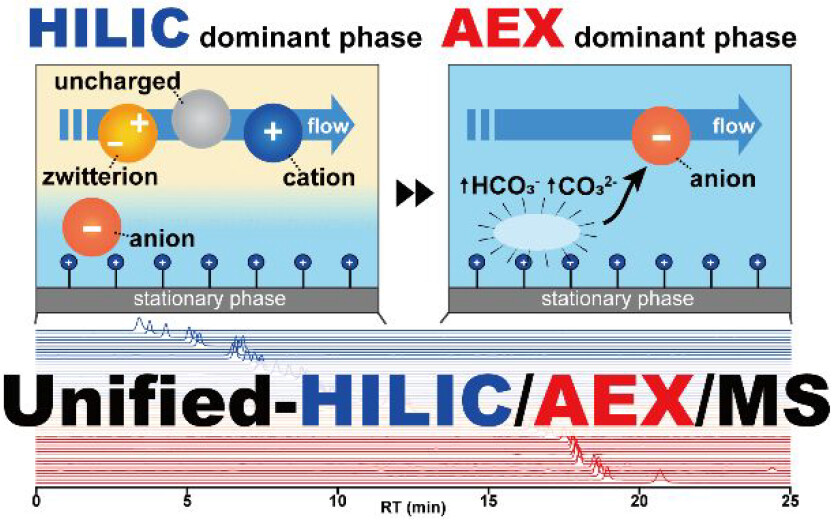
[Background and History of the Research]
Metabolites include components ingested through diet and those biosynthesized within the body from these components. In diseases, it is frequently observed that specific metabolites are overproduced or depleted. Therefore, detailed and continuous monitoring of metabolic balance is expected to contribute to early disease diagnosis and the development of new treatment strategies. However, it is extremely difficult to simultaneously measure the entire metabolome—comprising thousands of metabolites—in a single analysis. Consequently, cumbersome methods involving the combination of multiple analytical techniques across various platforms have been employed until now. Cohort studies handling large numbers of samples face the challenge of having to select specific analytical methods, which limits the metabolite information that can be utilized.
[Research Content and Results]
We focused on the fact that metabolites can be classified into two groups based on their charge: anionic and non-anionic (cationic, zwitterionic, and uncharged). Therefore, we investigated a separation method using a proprietary separation column with primary to tertiary amines and quaternary ammonium cations as the stationary phase. After detailed optimization of conditions, we developed a method in which hydrophilic interaction chromatography (HILIC) to adsorb anionic metabolites onto the positively charged stationary phase, while simultaneously separating and analyzing other cationic, zwitterionic, and uncharged metabolites based on differences in polarity. This is followed seamlessly by anion exchange chromatography (AEX) in the second half of the analysis to separate and analyze the anionic metabolites adsorbed onto the stationary phase based on differences in ionic strength. We named this newly developed separation and detection method “unified-HILIC/AEX/MS” and compared its analytical performance in metabolome analysis with conventional methods. The results confirmed that this method demonstrates superior performance to the measurement methods commonly used worldwide to date in terms of accuracy and the amount of metabolite information obtained.
【Future Prospects】
Going forward, this method is expected to revolutionize the metabolic measurements widely used around the world and serve as a new tool for elucidating the mechanisms of various diseases. In our laboratory, we plan to apply this method to metabolic studies of various model organisms, including human samples, with the aim of elucidating the molecular basis of biological phenomena involving metabolism. Furthermore, given this method’s exceptional ability to measure small-molecule compounds, it is expected to be utilized in various fields, such as functional food components, pharmacokinetics, and pesticide residues.
[Glossary]
(※1) Liquid Chromatography
A technique for separating compounds. It uses liquids such as water or organic solvents as the mobile phase. The sample passes through a column along with the mobile phase and is separated as it interacts with the stationary phase within the column. Since the elution time of each compound varies depending on the strength of this interaction, this elution time can be used to identify specific compounds.
(※2) Mass Spectrometry
An analytical method in which molecules are ionized, and the mass-to-charge ratio (mass number ÷ charge number) of the traveling ions is separated and detected using electrical and magnetic forces.
(※3) HILIC
In liquid chromatography, the name of the separation mode varies depending on the type of interaction. The method that separates compounds using hydrophilic interactions is called hydrophilic interaction chromatography (HILIC).
(※4) AEX
In liquid chromatography, the mode in which separation is based on ionic interactions is called ion chromatography. Specifically, when the analytes are anions, this method is called anion exchange chromatography (AEX).
[Publication Information]
Journal: Analytical Chemistry
Title: Unified-hydrophilic-interaction/anion-exchange liquid chromatography mass spectrometry (unified-HILIC/AEX/MS): A single-run method for comprehensive and simultaneous analysis of the polar metabolome
Authors: Kohta Nakatani, Yoshihiro Izumi, Masatomo Takahashi, Takeshi Bamba. (*Co-corresponding author)
DOI: 10.1021/acs.analchem.2c03986