
Projects
-
1) Research and development of implantable wireless brain-machine interfaces and related technologies
Brain-machine interfaces (BMI) enable disabled people to manipulate assistive communication devices and robotic arms as they intend by decoding brain activities using artificial intelligence (AI). BMIs are promising technologies that restore functions disturbed by various neurological diseases. We have established a BMI system that enables disabled people to manipulate assistive communication devices and robotic arms by decoding intracranical EEGs. Now we are developing an fully-implantable wireless EEG device aiming at medical approval and final clinical application of the implantable BMI system.
As well as the clinical application, we develop advanced technologies for future implantable BMIs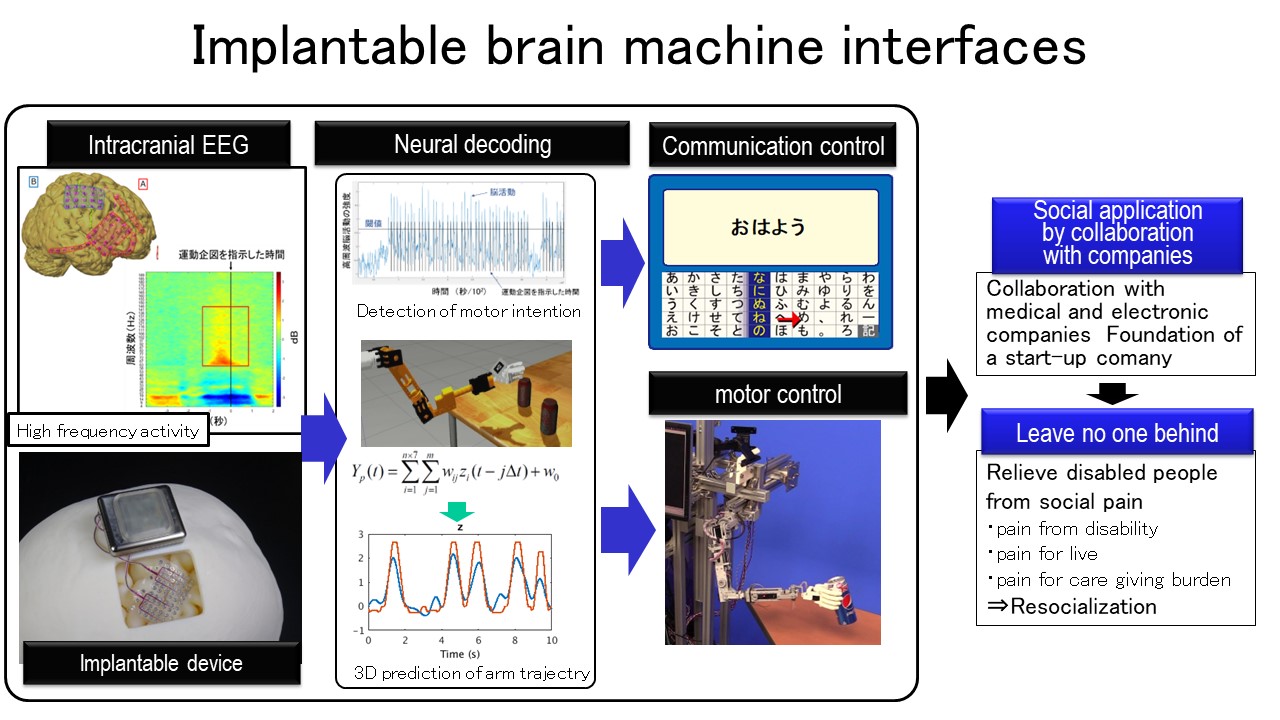
-
2) Collaborative exploratory research on non-pharmacological therapies for neurological disorders using sensory stimulation
-
3) Research and development of neural informatics, modulation and restoration related to 1) and 2)
Ongoing projects are as follows.
-
① Moonshot Project Goal 1: Realization of a society in which human beings can be free from limitations of body, brain, space, and time
Project Manager: Hiroshi Ishiguro
Task Leader: Masayuki Hirata
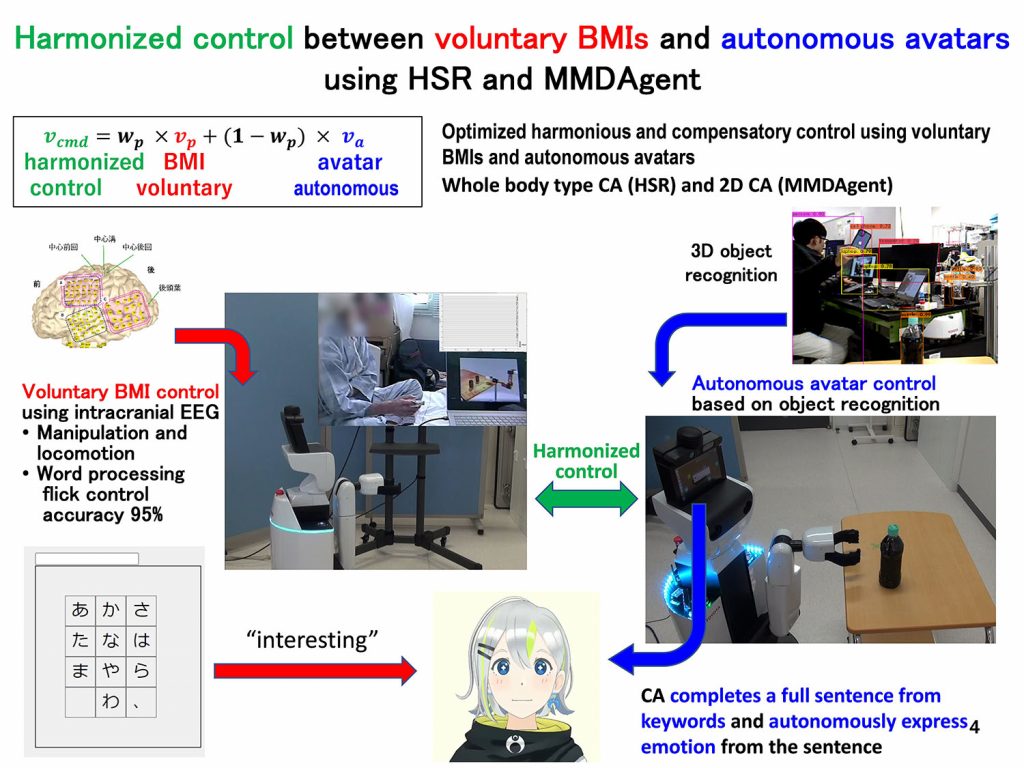
We aim to realize technology that can operate avatars as desired with BMI by optimally controlling BMI with excellent voluntariness and avatars with excellent autonomy in a complementary and harmonious manner.
-
Previous Projects
・National Institute of Information and Communications Technology (NICT): Research and Development of Core Technologies for the Realization of Next-Generation BMI Systems 2023-2025
・Grant-in-Aid for Scientific Research * (KAKENHI) (A): Fully implantable Functional Reconstruction by Brain-Machine Interface-Driven Functional Electrical Stimulation 2022-2024
・AMED ** AMED Medical-Engineering Collaboration:Project for Promoting Innovative Medical Devices: Development of Implantable Wireless Brain-Machine Interface System 2021-2024
・Grant-in-Aid for Scientific Research * JSPS Special Researcher Encouragement Fund : 2021-2024
・Grant-in-Aid for Scientific Research * (KAKENHI) (C) A new approach for reconstructing swallowing function using a brain-machine interface and non-invasive electrical brain stimulation 2019-2022
・Grant-in-Aid for Scientific Research * (KAKENHI) (A) :
Brain machine interfaces to restore swallowing function 2018-2020
・Grant-in-Aid for Scientific Research * (Young Scientists) :
Analysis of neural oscillations involved in human swallowing and decoding of swallowing-related neural activities 2018-2020
・National Institute of Information and Communications Technology (NICT) :
Development and application of an implantable device for brain-machine interfaces using high-speed wireless data transfer and big data analyses of neural information 2015-2019
・Ministry of Internal Affairs and Communications ‘Development of next generation artificial intelligence granted’:
Research and Development of the next generation AI Brain type cognitive classification technology inspired by the human brain cognitive mechanism 2017-2019
・AMED ** ‘Brain Mapping by Integrated Neurotechnologies for Disease Studies’:
Measurement of the body buried embedded integrated circuits built-in flexible ultra thin film sensor sheet using marmosets brain signal measurement system 2014-2018・Grant-in-Aid for Scientific Research * (KAKENHI) (B) :
Restoration of Swallowing Function based on Brain Machine Interfaces 2014-2016・AMED ** ‘Strategic Research Program for Brain Sciences’ :
BMI-based Restoration of Motor and Communication Control 2013-2017* the grant from the Japan Society for the Promotion of Science (JSPS)
** AMED:Japan Agency for Medical Research and Development