




ご挨拶
We had a seminar of Dr. Robert Gaunt and Mr. Nathan Copeland from Pittsburgh University, USA.
Nathan has motor paralysis in his limbs due to spinal cord injury and has no sensation below his thumb. The team, led by Dr. Robert, performed an operation to implant some electrodes into Nathan’s brain to decode his motor intentions to control a robot and to stimulate his sensory cortex to induce artificial sensations. Such technology is called Bidirectional BCI.
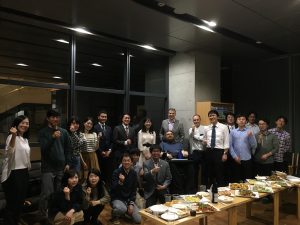
For the seminar, more than 100 people came. We could share the latest findings on the bidirectional BCI technology among researchers and Japanese patients with spinal cord injuries. And we discussed various issues to realize the clinical application of the BCI and how the electrical stimulation of the central nervous system will improve the patients’ lives.
We deeply appreciate Mr. Nathan and Dr. Robert for coming to Japan and giving these wonderful opportunities!
This seminar is supported by the Japan Science and Technology Agency, JST ERATO.
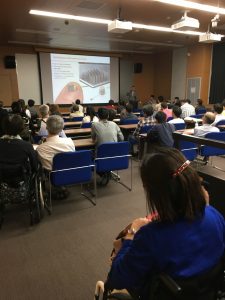
We could share the latest findings on the bidirectional BCI technology among researchers and Japanese patients with spinal cord injuries.
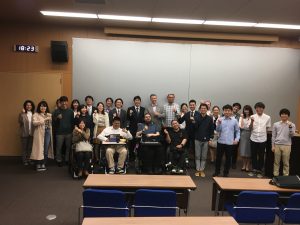
Lightsaber!
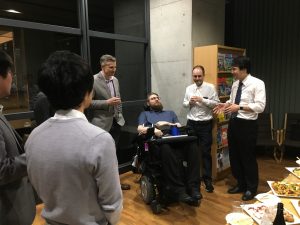
From the left Dr. Fukuma, Dr. Nishimoto, Dr. Robert, Mr. Nathan, Dr. Morris, and Dr.Yanagisawa.
We really enjoyed talking with you. Enjoy your stay in Japan!
Lightsaber! Again!
A new paper by Jo Aoe(Research assistants) was published in Scientific Reports.
「Automatic diagnosis of neurological diseases using MEG signals with a deep neural network」
Original code; https://github.com/yanagisawa-lab
Real-time neurofeedback to modulate β-band power in the subthalamic nucleus in Parkinson’s disease patients
http://www.eneuro.org/content/early/2018/12/14/ENEURO.0246-18.2018
12(H30.12)様式5-2(特任等教職員 英文)NeurosurgeryWe are seeking highly motivated individuals with PhD or equivalent, and with experience in human electrophysiology and computational technique to develop brain-computer interface using invasive signals of human. We are particularly interested in applications with deep learning method with big data of ECoG signals to develop novel communication tool using BCI. The appointment will be for five-year period with the possibility of extending further.
Requirements:
1) PhD degree in neuroscience, engineering or related field
2) Experience in electrophysiology, computational technique
To apply, please send CV by email to tyanagisawa AT nsurg.med.osaka-u.ac.jp
